Project fit & buying priorities
Oil, gas and chemical operators, EAM/IoT integrators, engineering contractors and project buyers can assess the workflow, integration and ongoing support together. Operations should define tasks and exceptions, IT should validate interfaces and access, and procurement should compare complete configurations and service scope.
Match tag durability, area classification and accessory scope to the project. RFID capability alone does not permit hazardous-area operation.
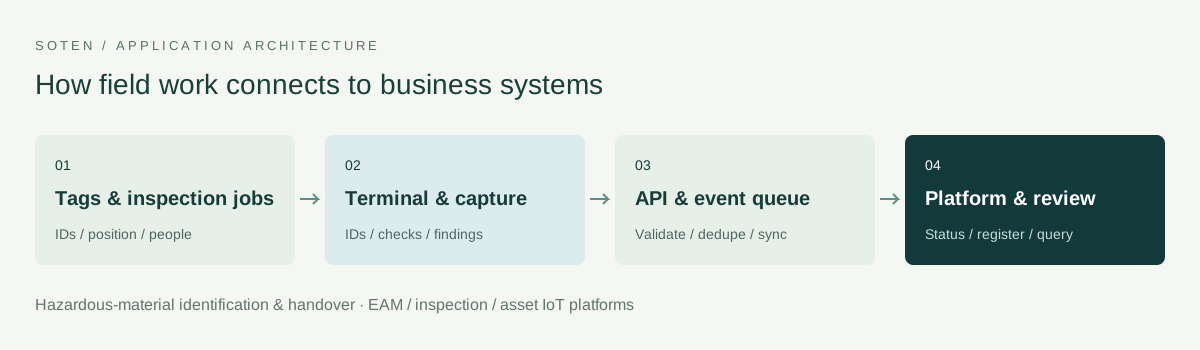
From field action to a complete record
- 01Check operating area and device configuration
- 02Read container or location IDs
- 03Link lots and handover records
- 04Return exceptions and reconcile the register
System integration & delivery responsibilities
Use container, storage location, lot, area, handover, discrepancy as the integration checklist. Define field ownership, required values and exception handling. Complete one representative job from terminal to API and backend review before scaling to more teams or sites.
SOTEN provides the selected terminal, capture options and interface support. Energy software partners own inspection and asset platforms. The project owner and specialists confirm area classification, certificate scope, installation and safe work.
Turn requirements into testable selection criteria
| Criterion | Confirm with the project team | Evidence to request |
|---|---|---|
| Use and configuration | Confirm capture methods, environment and operator interaction against the criteria above | Representative jobs, tags and peripheral list |
| Systems and interfaces | EAM / inspection / asset IoT platforms application version, fields, SDKs and protocols | Installable software, API specification and test account |
| Operations and support | Actual shifts, power, network, mounting and spare-unit plan | Full-shift test, installation drawing and support responsibilities |
Product platforms to evaluate
Select a platform by workflow, then confirm the branch, operating-system version and modules. The suggestions below do not mean every option is included in every configuration.

H81
UHF capture & hazardous-location branchMultifunction tablet for business forms and capture options; select the system platform and module combination.
View platform and configurations ↗
T80
Inspection forms & T80EX evaluationField tablet platform; review modules and interfaces for mapping, capture or hazardous-location branches.
View platform and configurations ↗
W105
Windows workflows & W105EX evaluationCandidate for Windows applications and peripherals; assess hazardous-location projects through the dedicated branch and certificate scope.
View platform and configurations ↗Pilot validation & procurement acceptance
Test real container tags in an approved environment for mismatches, missed reads, handover discrepancies and certificate/configuration alignment.
- Operations: confirm completion, exception review and result retrieval against real workflows.
- IT / integration: verify fields, permissions, offline recovery and duplicate handling.
- Procurement / support: freeze the tested device, software and accessories, and agree delivery, spares and service terms.
Questions before the project starts
Can this connect to our existing system?
EAM / inspection / asset IoT platforms are integration targets, subject to application compatibility, interface access and SDK validation. Share the software version, API specification and an anonymized workflow sample for a device pilot. Agree device supply, integration and rollout as explicit work packages.
What should we prepare before selecting pilot devices?
Provide area requirements, certificate conditions, tags and instruments, software interfaces and permitted pilot scope. Include deployment region, estimated quantity, project stage and intended rollout date to define candidate configurations and a test plan.
Project-document reference
For hazardous-location projects, consult the official EU ATEX information and have the project team review the selected model documentation against site requirements.